
A landmark regulatory change lowered the bar for market entry — and the numbers from July 2026 show just how much latent demand from the 100kW to 499kW segment had been waiting to exercise their power of choice.
For years, the Philippines’ Retail Competition and Open Access (RCOA) program — the mechanism that lets electricity end-users shop for their own supplier instead of relying on a captive utility — was effectively out of reach for anyone below 500 kW of demand. That excluded most mid-sized commercial operations: provincial schools, specialty clinics, boutique office buildings, and countless businesses whose consumption never came close to the 500 kW threshold, no matter how much they might have wanted the ability to negotiate their own rates.
That changed on June 26, 2026, when ERC Resolution No. 22, Series of 2025 took effect, cutting the contestability threshold from 500 kW to 100 kW. While it was a quiet regulatory adjustment on paper, it opened the market to an entirely new tier of Philippine businesses — and the data from the following month suggests the market had been waiting for monumental change.
The July Explosion
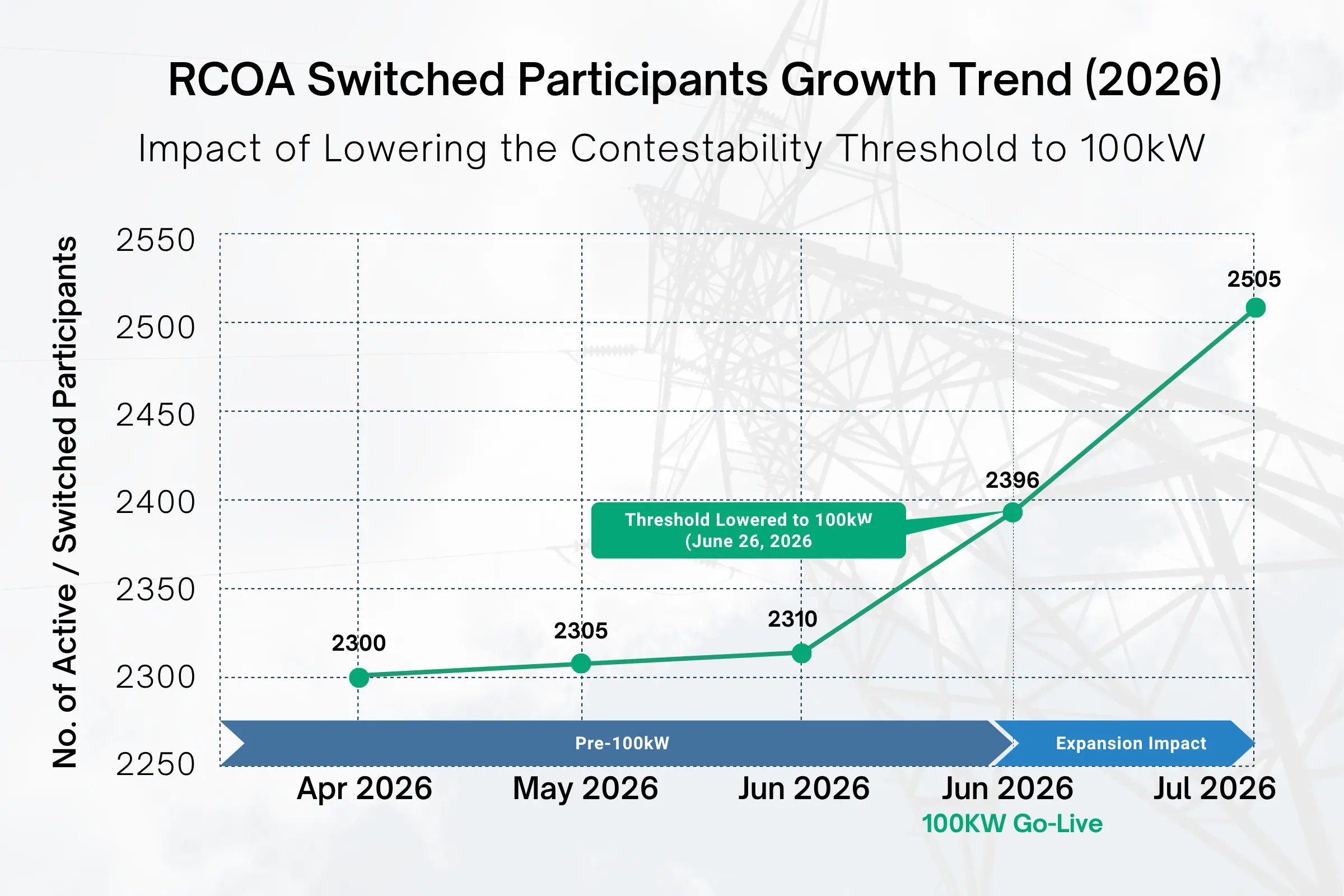
Contestable customer growth through the first half of 2026 was steady, unremarkable, and entirely linear. Then July happened.
Source: IEMOP
The comparison tells the real story. Between January and June, the market added 105 new contestable customers across five months — a slow, predictable climb. For the July 2026 Billing Period alone, 113 new customers registered, edging out the entire preceding half-year of growth in a single month.
This wasn’t gradual market maturation. It was a release valve opening. The 100 kW threshold had been holding back demand that was ready to switch to a Supplier the moment it was legally allowed to.
Aggregation: The On-Ramp for Smaller Players
Not every business that wanted into the contestable market could get there on its own. A 100 kW load, while newly eligible, still isn’t always enough to command strong terms in a one-on-one negotiation with a Retail Electricity Supplier (RES). That’s where Retail Aggregated Groups (RAGs) came in — pooling smaller loads together so members collectively reach the scale needed to negotiate competitively.
The growth curve here is just as telling as the customer numbers:
- January 2026: 113 Retail Aggregated Groups
- July 2026: 293 Retail Aggregated Groups
That’s 180 new groups since the start of the year, with 45 forming in July alone. Aggregation isn’t just a pricing tactic, either — pooling diverse load profiles also spreads out exposure to spot market volatility, giving smaller consumers a buffer against commercial risks that they’d have no way of managing independently.
What This Means Going Forward
By the end of July, IEMOP’s Central Registration and Settlement System (CRSS) was managing over 3,000 active RCOA participants and had settled a total metered quantity of 10,607 GWh for the month — a real-world stress test of the infrastructure underpinning retail switching, and one it clearly passed.
The bigger signal, though, is what this surge says about the market’s trajectory. The simultaneous rise in both individual contestable customers and aggregated groups points to a market that isn’t just growing — it’s maturing, with rising energy literacy and a genuine appetite for procurement autonomy among consumers who, a year ago, were not yet allowed to exercise their power of choice.
If the 100 kW threshold was the catalyst, it’s reasonable to expect immense market movements as RCOA and the Green Energy Option Program (GEOP) continue to expand. Each incremental drop in the eligibility bar chips away at the traditional utility monopoly model a little further. Based on what July showed, the market won’t need much convincing to keep moving through the door.
Automation is the Real Growth Engine for Retail Electricity Suppliers
As the 100kW threshold takes effect, RES business owners, who are key RCOA players, can scale their operations without driving up their overhead.
Backed by over 25 years of enterprise digital transformation and a 300+ strong engineering team, Exist Software Labs built eBillsync—not just as a billing tool, but as a high-velocity growth engine for the Philippine power sector.
Manual workflows shouldn’t cap your portfolio growth. By embedding automation into your RAP strategy, you can turn the 100kW threshold from a compliance obligation into your greatest expansion opportunity.
Ready to scale for the expanding retail market?
See other successful collaborations powered by Exist:
- IEMOP: Central Registration System 2.0
- Citicore: TheDigital Evolution of Citicore Renewable Energy Corporation
- TeaM Energy: WESM-Compliant Billing System Implementation with eBillsync
- Kratos RES: Customized Billing and Collection System Powered by Exist
- KEPCO SPC Power Corporation Advances Energy Digital Transformation with Exist Software Labs, Inc.