


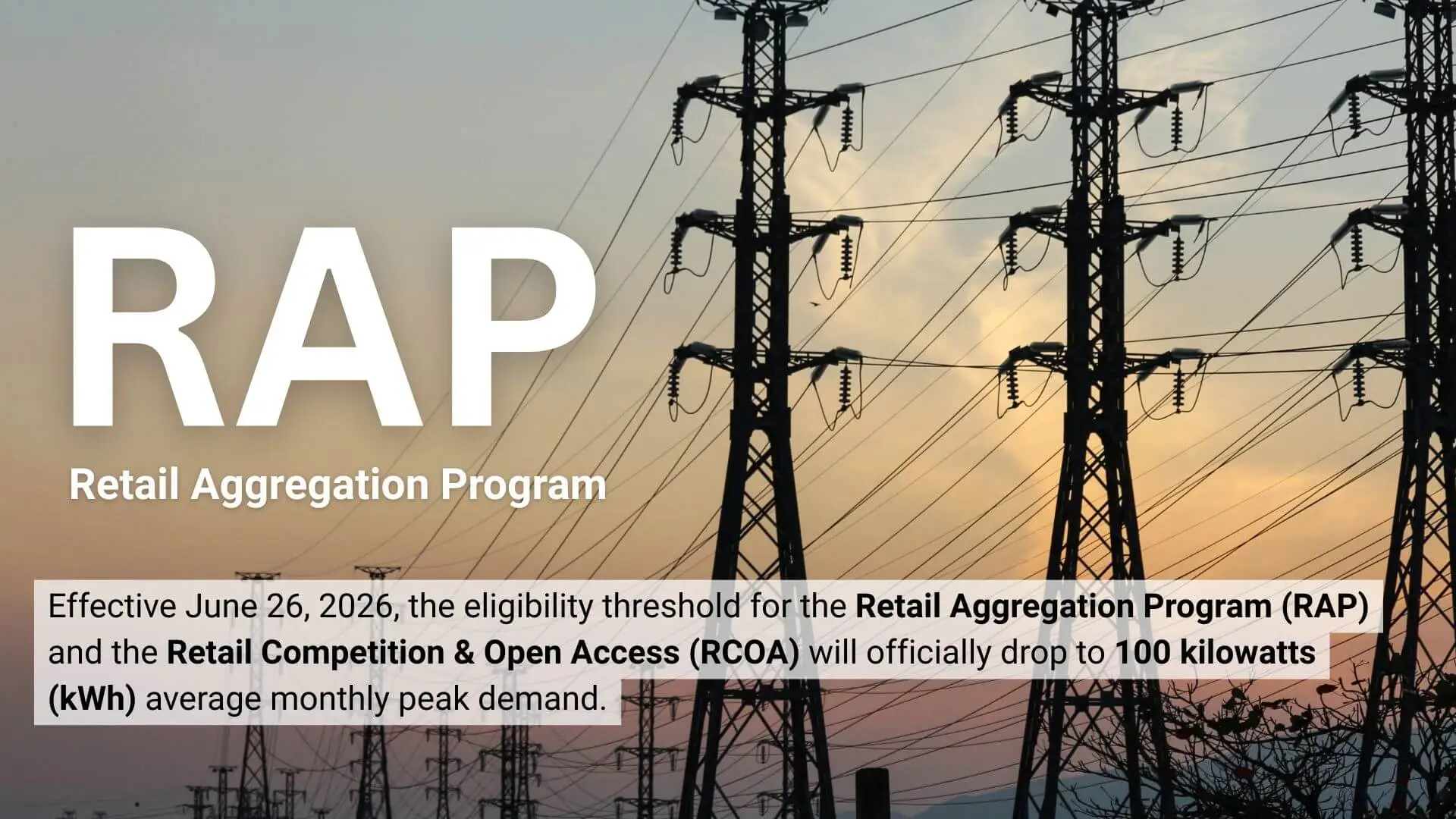
A landmark shift is coming to the Philippine energy sector. Effective June 26, 2026, the eligibility threshold for the Retail Aggregation Program (RAP) and the Retail Competition & Open Access (RCOA) will officially drop to 100 kilowatts (kWh) average monthly peak demand. This move is set to empower thousands of medium-sized enterprises by giving them the same “power of choice” previously reserved only for industrial giants.
Background: The Road to Retail Competition
The lowering of the threshold is a critical milestone in the implementation of the Electric Power Industry Reform Act (EPIRA) of 2001. For over two decades, the goal of EPIRA has been to move away from a monopolistic structure toward Retail Competition and Open Access (RCOA).
Initially, only very large consumers (1 MW and above) could choose their suppliers. Over time, the Energy Regulatory Commission (ERC) has gradually lowered this barrier. The Retail Aggregation Program (RAP) was specifically designed to help those who don’t meet the individual threshold on their own; it allows multiple nearby end-users—such as tenants in a mall or businesses in an industrial park—to “pool” their demand together to reach the contestability limit. By slashing this limit to 100 kWh, the ERC is effectively opening the market to over 12,000 new potential participants across Luzon, Visayas, and Mindanao.
Market Insights: Navigating Seasonal Volatility
As more businesses gain the ability to shop for their electricity, understanding market timing becomes essential. Chris Warren C. Manalo, Assistant Manager of IEMOP’s Market Simulation and Analysis Division, emphasizes that new participants must be mindful of how demand affects their bottom line:
“We can see that there will be an increase in demand. So therefore, there are increases in the prices during summer months.”
For the new 100 kWh class of consumers, the ability to switch to a Retail Electricity Supplier (RES) means they can negotiate fixed-rate contracts that protect them from these predictable seasonal price hikes, providing much-needed budget stability.
A Greener Outlook for 2026
The 2026 transition aligns with a major push for sustainability. According to the IEMOP 2026 Market Outlook, renewable energy (RE) integration is accelerating. By the time the 100 kWh threshold takes effect:
- RE Share: Projected to reach nearly 50% of the generation mix.
- Supply Reliability: Luzon is expected to maintain a supply margin of 3,368 MW, while Mindanao remains robust with a 1,120 MW margin.
- Smart Technology: The transition will be supported by the rollout of Advanced Metering Infrastructure (AMI), or smart meters, which are required for customers to participate in the competitive market.
Conclusion
The evolution of RAP and CREM signifies a more mature, transparent, and consumer-centric power grid. As businesses transition to the 100 kWh threshold, the need for precise data management becomes critical to successfully navigating this new landscape. For these 12,000+ new participants, the 2026 deadline is not just a regulatory date—it is an opportunity to take control of energy costs, automate complex operations through Energy System Solutions, and contribute to the Philippines’ “Clean Energy Scenario.”
Start your energy Digital Transformation Today!
Empower your business with efficiency, compliance, and innovation.